
The Shape Keeps Shifting: Alex Cuervo 🐳🩵
- rich awn

- Jan 3
- 20 min read
Editor’s Note from Sally 💌
I’ve been a longtime admirer of Alex. I first met her the way many people do—through her yoga classes, following her teaching quietly as she moved between spaces. From the beginning, there was so much to respect: her discipline, and yes—her practice is absolutely stunning. She teaches a wide range of classes, from the Classic 26+2 and Advanced 84 to her more recent Shapeshifting class.
Getting to know Alex beyond the hot room has been a slow, beautiful unfolding. This conversation adds real depth to what I’ve come to admire—the honesty and the rigor of her path, and the heart behind the work. She is generous and refreshingly real—one of the rare down-to-earth humans who truly lives what she teaches.
I’m deeply grateful she shared her story with us. Welcome to the Whaleness Club, Alex! 🐳
Intro & Interview by Rich Awn
Sometimes New York is less a place than a moment in time. I’ve come to know Alex Cuervo over the past few years, first as a student, then as a friend, and eventually as someone whose story feels strangely intertwined with my own. The New Jersey towns she grew up in, the schools she passed through, the scenes that shaped her—all of it overlaps with my own experience of New York.
It’s comforting to discover someone who had unknowingly traveled the same path. It's from that familiar ground that my conversation with Alex developed with sincerity and inspiration, revealing textures of these times and places that I hadn’t fully named before.
Alex is, above all, a teacher. She knows how to shape a room, how to listen, how to create the conditions where people can open, soften, and grow.
It’s a real honor to share this exchange between Alex and I.
✨✨✨

Richie: If you wouldn't mind stating your full name — who you are and what you do.
Alex: I go by Alex, but my full name is Alexandra Appleton-Cuervo — that's my married name. I'm a yoga instructor in Brooklyn and Manhattan. What else?
Richie: That's what we're here to find out.
Alex: I've been teaching for about 15 years now, practicing for over 20. Before yoga, I was doing freelance illustration. Before that, I was a semi-professional swing dancer — like Lindy Hop, big band swing.
Richie: Which is how you and Eric met.
Alex: Yes. We met at a dance studio. Before that, I was a fine arts painting major.
Richie: Where did you study?
Alex: I started at Parsons and then I wound up the School of Visual Arts. I took a long leave to dance but went back for illustration. Part of the reason I went back was the pressure from society. People shit talking about me. "She doesn't even have a degree.” I said fine, I'll get a degree. It's not that hard. So I did it.
Richie: I can relate.
Alex: You find your way. I’m glad I did it—it felt good to complete—but if I could do it again, I would’ve gone to a liberal arts school and focused on movement and dance. That’s what I really wanted. My family didn’t understand that. They’re all tactile visual artists—my sister’s a fashion designer, my mom’s a seamstress, my grandfather was a sculptor and painter. It’s strange, because movement as an art form isn’t that far removed from what they do.
Richie: That artistic lineage goes back to your grandfather—where was he from?
Alex: Colombia.
Richie: And he was a sculptor?
Alex:Mostly self-taught. He went back and forth between Colombia and the U.S. He worked in auto body shops and also painted the greyhound mascots on Greyhound buses. When I was growing up, he lived with us for a few years. He used to take Chivas Regal tin boxes and build sculptures—he made this little Eiffel Tower. It was really nice. He was funny.
Richie: Resourceful. Do you feel like you take after anyone in your family?
Alex: I only really know my mom’s side, and I don’t relate much to them. I didn’t know my father, and honestly, I think I’m better off. He doesn’t know me either. Maybe there’s something on that side I’d connect with more—but I don’t know.

Richie: We know what we can know.
Alex: We know what we choose to know in that regard. I just didn't want to invite more drama.
Richie: Is your sister from the same father?
Alex: Different father. I grew up with her as my sister. I didn't really clock that she was a half-sister until much later.
Richie: You're older than your sister?
Alex: No, younger. And it's a seven-year difference.
Richie: Interesting. I get older sibling vibes from you. You're so self-sufficient with innate leadership qualities. It comes through in your teaching and who you are.
Alex: I think that comes from not relating to my family at all. I’ve always felt like I had to forge my own path. Later in my 30s, I tried to bring my sister along—encouraging her that she could change her life—but eventually I had to accept that people are where they are.
Richie: Did you grow up in New Jersey?
Alex: I grew up in Hoboken. High school was in Fort Lee.
Richie: Sally also has roots in New Jersey. There’s a very specific energy there. What’s your relationship with it now?
Alex: I think everybody has a complicated relationship with where they grew up. Only recently have I felt pride about it. There was just so much Jersey-bashing over the decades.
Richie: Elementary school in Fort Lee too?
Alex: No—elementary was Hoboken. Junior high through high school was Fort Lee.
Richie: What did you aspire to be at that age, when you first became aware of what you could be?
Alex: I really just wanted to dance. Either that or a veterinarian but I'm allergic to everything, so I couldn't do that. I didn't know anybody who danced and it just didn't seem within the realm of my possibilities. When I tried as a teenager, I was working at a dance studio run by a very traditional Russian ballerina. She told me, “You can't. It's too late for you. Give it up.” I'm like, “Oh, okay.”
In art school, I lived with a very passionate, manic depressive painter who was very engaged with his work. Watching him made me realize I didn’t feel that way about what I was making. The only thing that held my attention—that really lit me up—was dance. I was reading Joseph Campbell and Martha Graham, learning that she didn’t start dancing until her 20s. That changed everything. It made me realize this path was still possible.
Not long after that, I stumbled into a swing dance workshop. They presented this old black-and-white 1930s footage of Lindy Hop swing, which is wild if you haven't seen it.

Richie: It's the wildest.
Alex: It’s amazing—beautiful. I saw it and thought, okay, I’ll do that. I rolled in at the right time for a swing dance craze that happened in the late 90s, early 2000s, and got into a dance troupe shortly after that. We got gigs — things like a video with Natalie Merchant and a documentary at Lincoln Center with Wynton Marsalis, a tribute to Duke Ellington. It was an amazing couple of tours.
At some point, I noticed my choreographer—he was in his 60s—walking with a cane, limping from years of dance injuries. I remember thinking, Is that what happens to dancers? That’s when I decided to stop. I had three or four deeply fulfilling years of professional dance and no regrets. If I’d started earlier, with more formal technique and a broader sense of what that career could look like, I might have stayed with it. Instead, I stepped away and eventually went back to school.
Richie: No formal dance training before your 20s?
Alex: I took a few ballet technique classes, but not anything more than a month at a time. It was really sparse.
Richie: So dance really took off for you in your 20s. Was Eric with you on those tours?
Alex: By the time we met, I already knew dance was it. I didn’t know what that would turn into—I just knew I was going to take it seriously, because it made me genuinely happy.

Richie: Did you embark on your yoga path during your time as a dancer?
Alex: I took my first yoga class in ’97—the same year I started swing dancing. Yoga definitely took a back seat. I was out dancing almost every night. When I stopped dancing, I started practicing yoga more seriously. My first Bikram class was in 2000. I kind of stumbled into it and had a long love–hate relationship with it.
Around that time I finished school and I was freelancing from home. It was really tough—I was alone most of the time, with no input from anybody.
Richie: This is when you began your professional illustration career?.
Alex: Yes. And that’s also when I found another Bikram studio where the consistency really landed for me—the repetition, the discipline, holding a posture while breathing and looking at yourself.
The whole thing was so surprising. It was surprising how intense it was and how afterwards you're just knocked out – you're knocked sideways. I was left feeling so peaceful.
Richie: What a feeling that is.
Alex: After a few years of that I started doing a work-study for Roody Senecal at the former Yoga Tribe location on 15th Street in Park Slope. I did another training before that, and then Bikram training afterward.
Richie: You trained with Roody?
Alex: Not directly—My first training was with his partner at the time. She was opening a studio that wasn’t exclusively Bikram, which was not "officially" allowed then. Around 2010, you couldn’t really mix styles. She sent me to a training that was Bikram-adjacent but not officially Bikram. On the first day, I remember thinking, I should be in Bikram training. But I stayed and finished. A few months later, I went to Bikram training.
Richie: Does your perspective about the control you have of your body, the exertion that you put into dance, inform what you do in training as a yoga teacher, as a practitioner, as an enthusiast, as someone who finds pleasure and joy in this practice? I'm curious about your relationship with your body.
Alex: The perspective I have as a practitioner has had to change from my perspective as a teacher. The two definitely inform each other but as a practitioner, it's the discovery of a different relationship with your body that is forever fascinating to me. It's physical but also emotional and mental.
I had to learn to separate my expectations from other people’s practices. I can’t project my goals onto someone else. You learn to meet students where they are—not where you think they should be. It's not something a student will verbally tell you but you can see that some students don't actually want to go further than they could. They were not necessarily trying to get into a split in standing bow, so I’ve developed the skill to observe the level of the student over time. Maybe they just want to balance to survive. So I appreciate that more now.
When I started teaching, I couldn't wrap my head around why someone wouldn't want to go further. I would think, Why wouldn’t you? It’s so beautiful. It's like a flower blooming. There’s this beauty within it when you feel it and when you see it. There is an aesthetic appeal to it for me and because of that aesthetic appeal, I've learned so much more about it.
There are deeper layers that reveal themselves so that keeps it interesting and educational. It does inform how I teach, which is more a part of how I communicate. Eric's a teacher too so we like nerding out about how people learn, how to read a room, when to cue visually, verbally, or with touch—and when not to.
Teaching took me longer to grow into because I didn't want to teach. I'm pretty introverted and shy. Eric was the one who said, You’re spending a lot of money on classes. Just go to training. You can take class for free. This made sense to me.
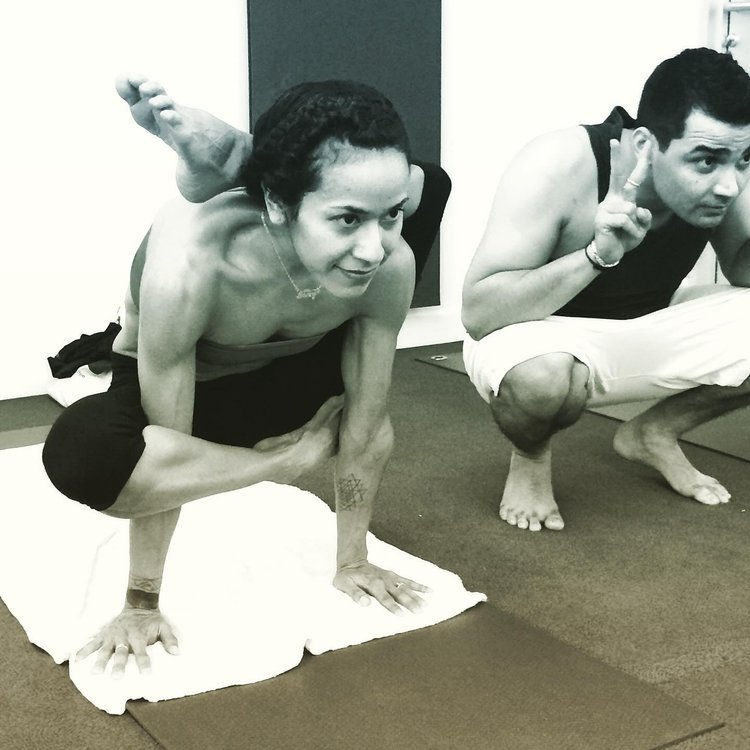
Richie: Practical advice. Necessity is the mother of invention. To that, what keeps you curious and keeps you going?
Alex: Until a couple of years ago, I didn’t even realize I’d become one of the senior teachers at Yoga Tribe. I did not ask to be this kind of authority figure. I decided to step up and accept the offer to co-lead teacher trainings.
Richie: So you’re taking ownership of that role.
Alex: Yes. And when it comes to my own practice, two things really stand out. First, I still want to grow—but I’m realistic. I know there are limits that come with age, and I’m not interested in punishing myself. That’s not the point. The point is maintaining the practice I have while exploring all the different ways people can access it. If someone can’t do this, maybe they can do that. Modifications matter.
I’m also constantly asking: What else is going on inside the body? And how do I find language for that? That exploration of different entry points and different bodies—That's become much more interesting to me.
The second thing is presence. Being fully present for students. That never gets old, and it’s always a challenge. I’m constantly having to put my ego aside. As a teacher, you do have to hold authority—but you also have to forget yourself. The real work is staying attuned to the group dynamic in the room. When you can do that, when you lead from that place, it feels wonderful.
Even if somebody knocks you off that plane and your ego gets bruised because somebody's doing something weird — if I allow that person to affect what I’m saying, it affects the whole room. The question becomes: How can I be here for this person and that person at the same time? Some students want attention. Some don’t want to be seen at all. Some want hands-on adjustments. Others don’t. I can’t read minds but through presence, I can a little bit.
As a shy person, teaching doesn't come easily and there used to be a lot of agita. The story I tell to the teacher trainees is on the day of my first class out of Bikram training, I was in the emergency room because of a panic attack. I had crippling stomach pain for hours and I wound up in the ER. That's the only time I've ever been hospitalized. It took a long time for me to get over that anxiety.
Richie: You’re an incredible teacher—and you’re so modest that most people don’t even know you qualified as a USA Yoga champion.
Alex: I'm not a champion — but I did qualify.
Richie: Tell me about that experience.
Alex: I was introduced to the USA Yoga Federation competition by two women who led a class at one of my trainings. It was awesome. It knocked me sideways, the beauty of it. One of them was a champion from Copenhagen. In NYC if you wanted admission to advanced classes—and weren’t already a Bikram teacher—you'd need to commit to competition. I didn’t want to wait until after Bikram training. I wanted to start immediately. So I said yes.
Again, performance anxiety was a lot. I’d competed as a swing dancer before, so I understood how competition can be a metric—you see where you’re at. There’s nothing more present than those three minutes alone on stage, balancing on one leg in a leotard. This was 2011, and at that time there were at least three advanced classes every week. It was awesome.
At that time I was training with people like Joseph Encinia, who was a champion, Jared McCann, who was a champion, Gloria Suen, who's a champion. They were all moving around and leading these advanced classes. It was an embarrassment of riches. I got a lot of education from that and it was a great way to set goals. Training for it is like training for a marathon but every time, I'd get crippling anxiety.
Richie: It’s almost like an Olympic event—or even a beauty pageant.
Alex: The goal of USA Yoga as an entity is to qualify as an Olympic sport. And it’s funny you mention that—there was a time when competitors were judged on physical proportions. They don’t do that anymore.
Richie: I’m glad they scrapped that.
Alex: Yeah, that could be really weird. I mean, it's already so difficult to just rate their postures on their own, but to add the element of appearance or body type to it is pretty sketchy.
Richie: Do certain body types have an advantage over others?
Alex: Absolutely. Torso length relative to legs, arm length, overall proportions—and size is a whole other factor.
Richie: What are your takeaways from that experience? You placed, you overcame your anxiety. You were able to get on that damn stage. You got judged.
Alex: By the last two times I competed, I was actually enjoying myself on stage. Then COVID hit and everything went online. Now you can choose to compete in person or submit a video. I’ve thought about doing it again, but I don’t have the same community I had back then. Some people use it now just to maintain a certain level.
Richie: Was that your first interaction with Jared, or did training with him come later?
Alex: I knew him later as a competitor when he was teaching at Yoga to the People, but I actually first met him at Bikram Yoga Lower East Side.
Richie: Was that the place on the corner on the second floor?
Alex: Yeah! That was one of the best. I taught there for a little bit.
Richie: I probably took your class. But then Jared became your teacher?
Alex: I knew him in passing at first. I’d see him in advanced class—he helped me a few times, and his practice was obviously amazing. We ended up competing in the same competition at one point. Later, when he started Lighthouse Yoga School, someone I knew joined his first training, and I signed up for the second. I knew I needed a vinyasa training, and I knew he’d be great. He was.
Richie: He's the greatest. Love Jared.
Alex: He's such a character.
Richie: He really is such a sponge for everything. His story is similar to yours in that you are both really, really good at what you do. I think I overheard you say this once, even to Sally, that when you go into a posture, you really go into a posture. You give it your whole 100,000% every single time. When I practice, I think about what you said, and it brings me further. It gets me to breathe more. It gets my spine to bend further.
Alex: Firstly, I want to correct you. I try to give my 100%. I'm like anybody else. Sometimes I get lazy and I fall into bad habits. I had to get knocked out of them. When I'm in class, I'm not looking at anybody else because I'm locked in, but of course I get lazy.
Richie: Thank you for that clarification. Another teacher you brought up in your class recently was Mary Jarvis. Where did your paths intersect and how has she been influential in your development?
Alex: In my first year of doing advanced class, somebody told me about Esak Garcia who has his own workshops and trainings but back then, he was just starting to do that. He was the first yogi to win the competition under Mary's tutelage. He fully gave himself over to her and was adamant that she train him. He wanted to do a handstand Scorpion and he demanded she train him and initially she refused. Eventually she agreed, but only if he followed everything she said without argument. He did—and he won.
A lot of the drills he shared came directly from her similar to what we do in my Shapeshifting class. That’s how I started doing wall walks and deeper backbends. My early exposure to Mary’s work was actually through Esak.
She was elusive to me in the beginning. She still had a studio in California and wasn't traveling much. After she closed it, she and Esak started teaching workshops together, and she became more available. I officially met her in 2013 at a friend’s studio in Binghamton. I took more workshops there and later did her first Shapeshifting training in Lake Michigan in 2019.
Working with Mary is always a longer process. In some ways it’s harder, in others easier. My classes have to fit into 90 minutes—hers unfold over much longer periods. She talks a lot, shares stories about herself and about Bikram. It’s expansive. You live inside the work.

Richie: Is she one of the OG Bikramis under the man himself?
Alex: Yes. She was running his first school in San Francisco in the mid-90s. She spent a lot of time with Bikram. At the time of her training with him, it was a really small group and she would get a lot more one-on-one time with him. He would come and visit her at the studio, which he wouldn't do now of course. At some point he couldn’t personally visit studios with his name on it because there were so many! I think after LA, San Francisco was the second official Bikram studio, maybe the third after Hawaii.
She's got a lot of input and if you would take beginner class with her, it's a little different because she started her version of the class long before the established dialogue you’re used to hearing in a modern Bikram class. She doesn't really use dialogue very much. What she teaches is the way she did it with Bikram. It's basically the same but little differences like turning your head first in a triangle is one thing. She is just as tough and strict as Bikram. No water bottles in the room, for example.
She's a really tough lady but also very generous with her love and care. If you were training with her and she knew you were competing, she'd send you a lot of texts and a lot of advice and encouragement.
Richie:Early Bikram teachers were pretty mean—and honestly, I kind of liked it. Do you think people were drawn to that?
Alex: That came straight from Bikram. He was extremely strict in how he taught. Maybe it was cultural, maybe just his personality. You could compare it to martial arts—or ballet training. It's tough. There’s one way. You do it or you don’t.
Richie: Seems like with these two disciplines, dance and yoga, it's either a mean Russian lady or a mean Indian man.
Alex: Right. That's the other thing that I was drawn to — there's only one way to do it. With vinyasa classes back then, you can do it this way or that way and I'd be thinking, Just give me the one fucking way to do it! . With Bikram class, there was no question. This is the way you do it. If you can't do it, you keep trying to do it this way.
Richie: I love the simplicity of that.
Alex: This is the bar—just show me where it is and I’ll try to get there. When there are too many options, I don’t know where I stand. As rigid as it sounds, I was really drawn to that discipline. I didn’t have the dance foundation I wanted, so this gave me structure.
That said, Bikram’s teaching doesn’t always translate well on paper. When you practiced with him, he actually had a sense of humor. He could lighten the room. He was an entertainer. He could also be super offensive—and a real fucking jerk.
Richie: You took his training too?
Alex: Yes, in 2011.
Richie: That was right in the pocket of his popularity. Right before all the allegations.
Alex: But by then we’d already heard rumors. It was already split and that whole drama.
Richie: Even Yoga to the People had their own similar issues. Why?
Alex: Ego. Ego is a cancer.
Richie: Isn’t yoga all about peace and our bodies and introspection? It’s the wildest contradiction.
Alex: It felt that way to me for the longest time, too. But if you look at Bikram’s lineage, it’s much more bare-bones and physical. Bishnu Ghosh, before he started a yoga school, he had a weight training school, it was called The College of Physical Education in Calcutta in 1923. His brother, Paramahansa Yogananda, had come back from a tour after he’d written his famous book, The Autobiography of Yogi. He came back to India after years of touring in the West and that's when Bishnu got inspired by his brother Paramahansa to start a yoga school together. That's the lineage that Bikram yoga comes from. It was more practical. It wasn't concerned with the spiritual as much.
When Bikram tells the story at his teacher's school, he recounts how Bishnu would assign him to a student. He would be assigned to these students, who were treated more like patients, to teach them specific postures that would help relieve them of a certain ailment. He would say, “Bikram, go to this room and take this person with you and tell them how to do this posture, this posture, and this posture,” for whatever their ailment might have been.
Richie: Sort of like an Ayurveda or medicinal form of yoga?
Alex: Yeah, like that. There was no spiritual overlay. The point was medicinal.
The class was developed from postures that would alleviate the pains of the typical Western body. The heat was added to help flexibility. You’re there to survive the class. You better focus on your breath. The breath brings you to that place of something like spirituality but it takes students a while to reach it. Think of it in very practical terms: If I don't focus on my breath and have awareness that I’m breathing, I'm going to pass out.
After a while you realize your brain feels quiet and you feel so much more calm and everything feels more loose.
Richie: And what is that feeling?
Alex: It's the closest thing I'd experienced to meditation at that point. It's not a substitute for it but that was the first indication of what this could be.
Richie: I never even considered the lack of the devotional element in Bikram.
Alex: There's none. There's no spiritual element.
Richie: I was lumping it in with other Vedic practices.
Alex: There were never mentions of any deities or we're going to be doing some oms now. The attention to the breath meant only that. Breath is just breath. But if you really focus on it, that connection can feel spiritual. It's baked into anything that gets you out of your scramble of thoughts. You are tapping into a higher self.
In a seated meditation practice, all you're trying to do is release back into yourself, into something that's outside your ego. It's so basic. The spirituality just comes from there.
Richie: Did Bikram incorporate any yoga science or history into his training?
Alex: Yes. He knew all of it—sutras, philosophy, yoga science. He lectured on it. But his message was always: In a 90-minute beginner class, there’s no time for that. It’s enough for people to be in their bodies.
Richie: Well, that's the genius of his practice and that empire and why it proliferated. It appealed to a fitness craze in the U.S., everybody taking aerobics classes and such.
Alex: If you think about it, Bikram fused the two. There's no music, it's not entertainment, but it's a workout, and you are just a puddle at the end of the thing, and it's effective.
Richie: He knew he had a secret weapon—and that he could monetize it.
Alex: Well, applying the heat was certainly a boon.
Richie: Where did you take your Bikram training?
Alex: In LA and it was in a convention center at the Radisson LAX.
Richie: How did they actually heat the room?
Alex: You could see these huge tubes that they had to bring into the ballroom. Our yoga studio was the ballroom. Heaters were blowing hot air into the ballroom. Of course, our training is 400 people, so that adds to it.
Richie: You got body heat, you got heat blowing on you, people passing out. Sounds like a blood bath.
Alex: Well, love him or hate him, this lineage has brought all of us together.
Richie: Straight up. Maybe now we can all feel some degree of moral scruples in our own life that can't really be defined by our past or his past.
Alex: Those are not my problems.

Richie: Exactly. Now that you're such a pro, do you feel like your next move is to go on tour? Do you have your own Bikram sequence that you want to market? What's next for you?
Alex: Now, I just want to do more of what I'm doing. I'm co-hosting retreats with Caro Lokah. Beyond that, I just want to be a better teacher. That's all I really want to do. I want to get better at reading the room. I want to get better at helping people, tapping into their strengths and helping them get to the place they want to be and sending them further than they thought they could.
When students are starting out, they don't know that that's a possibility for them. I am trying to be more of a mentor because that's how I got here. Through the kindness of people around me. Jared is one of them.
Richie: Jared's the king of that.
Alex: We were taking class together — he wasn't the teacher — but he was generous enough to take time out from his practice to help me with my practice. We didn't know each other. It was just so kind. That's another reason why I love him and why I wanted to follow him. Of course, his practice is amazing. Mine was not so much at that time.
That's what I want to do. I want to be more of that. I don't have kids and I won't have kids. I'm slipping into my mama mentor shoes to help people out. I can't help others if I'm not doing that for myself. I don't plan on just sitting on a cushion and telling people what to do with their bodies. I have to practice myself too because otherwise I won't be happy. That's all.
Richie: Thank you so much. What a beautiful conversation.
Alex: I forgot — you're a Jersey boy too. Respect.
✨✨✨
Outro by Rich Awn
Knowing how a teacher was taught adds real weight to what they offer. Alex’s education—shaped by world-class champions and foundational figures in modern yoga—is rare, and it shows in how she teaches, observes, and holds space.
To experience what Alex has to offer, jump into one of her classes either at Yoga Tribe in Brooklyn or Spirit Lab in Manhattan. Or better yet, sign up for one of her trainings or retreats ongoing throughout the year, private instruction, or illustration services through her website here.


Alex 🩵🩵🩵🩵🩵🩵🩵